
The whole argument · five minutes
Seven claims, each with its evidence attached.
The rest of the site argues these at full length. This page is the spine — read it and you know what FrogNet claims, what has been shown, and where to push back.
Message choreography may be the assembly language of distributed systems.
Requests, replies, retries, serialization, discovery, failure handling — a large fraction of distributed application code exists because the programming surface forces communication to be expressed explicitly. On a FrogNet, wide-area distributed programs don't talk to each other. They share memory. REST isn't gone — it's underneath, where assembly went when programmers moved to C.
It worked across a continent, with a witness.
17 April 2026: Dan changed a value in New York. The value traveled through Seattle. A lamp three feet from him came on. His program didn't know Seattle existed, or the lamp — it wrote memory. Externally hosted; an external witness.
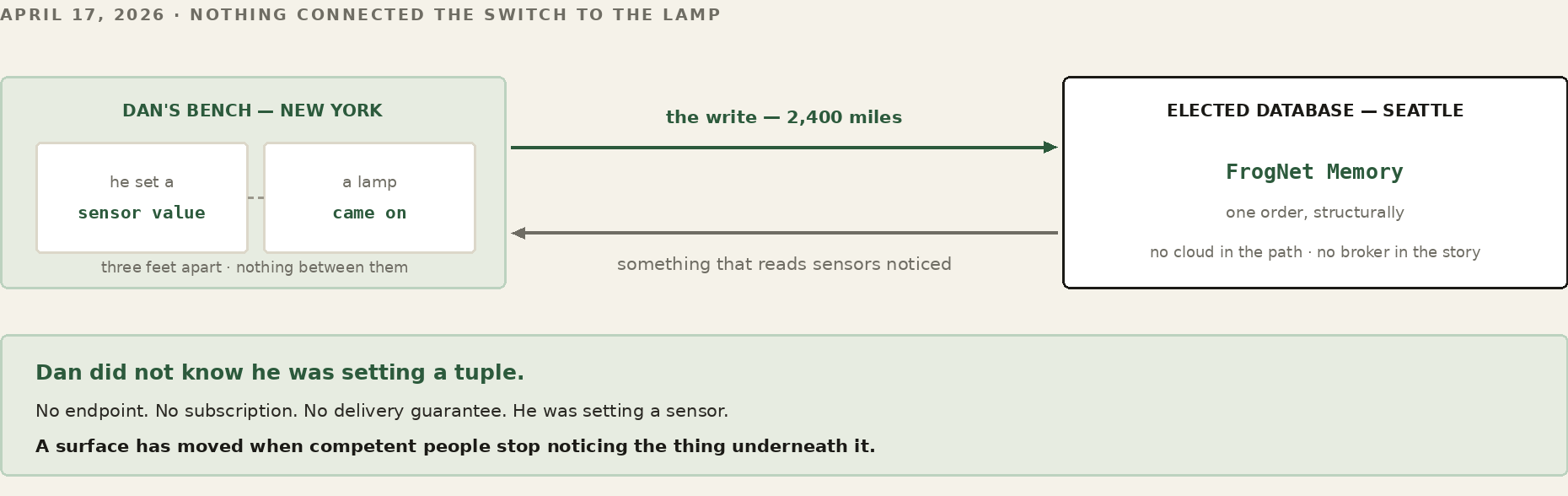
The proof is the code that isn't there.
The network monitor does Nagios' job with no agent, no server, no check definitions — two HTTP calls and a name. No endpoint to design, no verb to choose, no status code to map. The last five bugs you chased in a distributed system were probably in code this model doesn't have.
The abstraction survives a hostile network.
A transcontinental HD call over an 850 Kbps link, degrading through 450 and recovering without redialing. On camera, the ladder walks from 1080 down to 160×120 — 164 Kbps, audio holding, no dropped frames — and climbs back. The wire carries diffs against structure both ends already hold: one measured megabyte of JSON moved as 92 KB.
There is no application surface to attack — said falsifiably.
One port must answer. Here is the host, here is the port: nmap came back with "1 service unrecognized despite returning data," and the scan is published as it ran, shared website ports and all. Not invulnerability — the real threat vectors are listed next to it.
The boundaries are stated, not hidden.
Bounded stale state, no cross-value transactions, an allocator ceiling of ~56 nodes per tunnel with the arithmetic published, and a memory contract whose clauses are marked verified, implied, or undetermined. The six ways its own author got the model wrong in one day have their own page.
Don't believe any of it. Make it fail.
A simulator for arbitrary topologies, named oracles with defined failure conditions — take the broker, show the pivot — and seats for the people who want to argue with the spec rather than the marketing. A red run is a finding; a hypothetical is not.
We built the machine. Now prove us wrong.