The product
One stack. A box, a protocol, and the apps that ride it.
FrogNet is not a cloud you rent — it is software you install and own. A node turns any spare computer into a piece of a self-forming network; UnREST is the protocol that moves memory instead of messages; and a suite of real applications already runs on top. Free to build on, licensed when you ship.
The Communicator — the flagship application.
Five parts, one network.
Everything below is the same system seen from a different seat — the box you install, the protocol you build on, the rendezvous that joins sites, the flagship app, and the everyday suite. You can adopt one part without the others.
The Node
Any spare box becomes a self-forming, self-healing piece of the mesh. Discovers its neighbours, elects roles, projects Wi-Fi, routes over any bearer.
UnREST
The protocol and handler framework. Exchange memory, not messages — SAME / DIFF / FULL on the wire, and your own protocols on the same interface.
The Broker
A stateless introducer that joins nodes across the internet with WireGuard tunnels. Holds no truth, no endpoint keys, and no membership of its own — though every cross-site packet transits it.
The Communicator
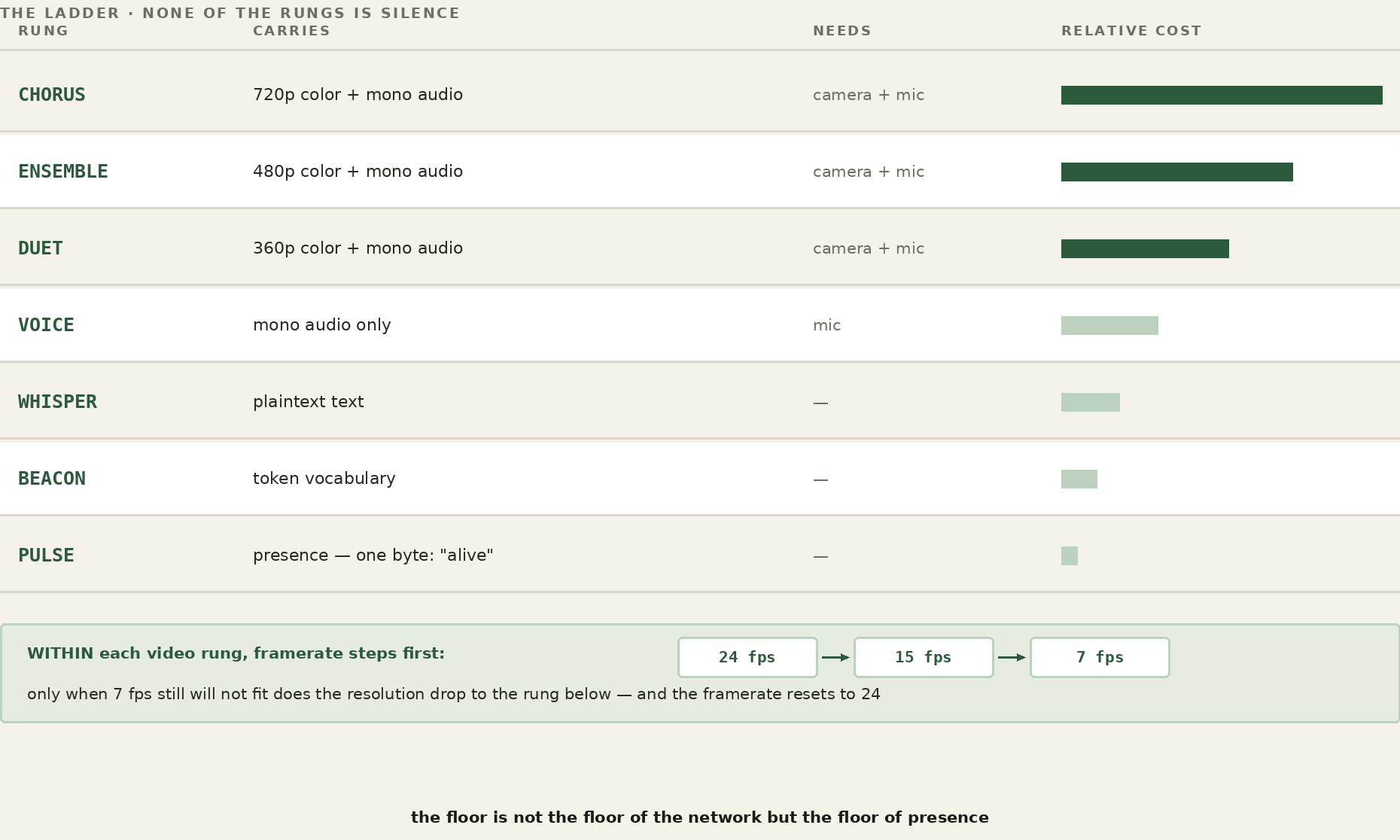
Presence, chat, calls, and games over one shared memory — with SotF, the adaptive media ladder that holds a call from HD down to a heartbeat.
The Apps
FrogChat, the Family app, the Network Monitor, file sync, sensor bridges, board games — the software that has run a household for years.
The network is the database
Underneath all five: a shared operational memory the whole mesh reads and writes. Address by what a thing is, not who has it — three indices, query any combination, and the value is JSON. The books explain why →
The Node.
Install the frozen FrogNet world on any Linux box — a Raspberry Pi, a mini-PC, an old laptop — and it becomes a lillypad: a sovereign node that configures its own networking, stands up its own Wi-Fi when there is no wire, discovers every neighbour it can reach, and takes on whatever role it is most capable of. No controller, no account, no cloud. Its identity is a GUID minted once at install; its address is its own. Pull the uplink and it keeps working — a lost link is normal weather, not an outage.
One node is a complete network. Add a second and they find each other; add a tenth and nothing changes but the reach.
- Runs on
- Pi-class · mini-PC · x86 Linux
- Identity
- /etc/fnid GUID
- Networking
- self-configuring at boot
- Discovery
- bounded HTTP walk
- Partition
- split & merge, automatic
- Install
- one script, offline
Connectivity is accomplished by transport — not the other way around.
A transport is a way to move bytes. Connectivity is people and machines that keep reaching each other while conditions change. Most stacks start from a transport and build the solution around it — so the solution dies with the transport. FrogNet starts from connectivity, and every transport is interchangeable weather. Here is what's in, what's out, and why.
Ham is out — up front, before anything else. FrogNet's wire traffic is differences against state the far end already holds — frames a third party cannot read without the memory they refer to. The prevailing reading of FCC Part 97.113(a)(4) treats that as a message encoded to obscure its meaning, and amateur bands prohibit those. So FrogNet does not transmit on amateur radio bands — stated here the same way it's stated in the book. And Reticulum is out with it, on the same rule for the same reason: every Reticulum packet is encrypted by design, and by the project's own account that cannot be turned off. Whatever you think of either stack, neither one can legally carry its traffic over ham spectrum in the US.
Now the honest part about the alternative. Look at how amateur traffic actually moves. The RF hop is audio — software modems pushing tones through a voice radio, the same idea as a dial-up modem and at kindred speeds: 1200-baud packet still keys the Bell 202 tones of the acoustic-coupler era, and even the best modern HF modes deliver a few kilobits. And the moment the message needs to go farther than the radio reaches, it backhauls over the internet: Winlink through CMS servers, AREDN islands joined by tunnels over home broadband, EchoLink voice over IP by name. The screech does the last mile; the internet does the miles — in the clear, because the bands require it. FrogNet was built on accepting that fact instead of dressing it up: when the path must cross the internet, it crosses inside a WireGuard tunnel you own, on your own flat 10/8, through a relay that cannot read a byte.
Ethernet · Wi-Fi
The LAN case. Nodes on a switch or an access point find each other unaided — and a node with no wire stands up its own Wi-Fi. Running in production for years.
WireGuard tunnels
Cross-site links ride encrypted tunnels on your own flat 10/8, introduced by the broker — which terminates them but, running none of the semantic stack, can reconstruct nothing that crosses it. two years and counting in production, coast to coast.
900 MHz · HaLow
The unlicensed band where compression and encryption are simply legal. An HD call has crossed the country over it, and a node was driven through Queens on it without a drop.
LoRa · MeshTastic bridges
Sensor-grade RF across acres the carriers gave up on. Bridges write RF-delivered readings straight into shared memory as sensor rows.
Starlink & friends
Starlink supplies one network — the pipe to the internet. FrogNet supplies more than one: the local fabric keeps running on Wi-Fi and radio with the dish dark, and the cross-site tunnels light back up the moment it returns. One dish has fed dozens of working nodes without saturating the pipe.
The general rule
Fiber, a phone's tether, point-to-point microwave — if two points can exchange bytes by any means, FrogNet links them. The application never sees the difference; that is what transport-independent means.
And transports combine — in one node, and across the network. A single node can carry several bearers at once, and a network mixes them by role: one machine is the tunnel gateway, another is the 900 MHz gateway, a third reaches its upstream on eth1 — and the fabric routes over whichever path reaches. The flagship call ran wired Wi-Fi, an encrypted internet tunnel, and a 900 MHz radio in one session. No node cares which bearer its neighbour used to get there.
One pond, three ways in and out — every link two-way, every methodology different
The same property is what makes FrogNet mobile. A device does not care what the transport is, so when it comes in contact with another FrogNet it latches onto whatever medium is available — with no operator intervention in most cases. A node has been driven through Queens at traffic speed on exactly this behavior: the topology changed under the mesh block by block and the walk re-formed it, nobody touching anything. That is the differentiator with a human face: people do not have to be network or RF engineers to get things up and working in the field.
transport independence → discovery & route optimization → route resilience & fault tolerance → system survivability
Each stage exists because the one before it feeds it. Survivability isn't a feature bolted on at the top — it's the last link of a chain that begins with refusing to care what the wire is. The wire and the radio — Magnum Croakus § 5 →
Ham is a transport. FrogNet is a solution. When a band can't carry the traffic, the solution routes around the band — that is the whole idea.
UnREST — the protocol you build on.
The web asks; UnREST remembers. Not a new protocol and not a faster transport — the same primitives you already use, arranged so both ends hold the same structure and only the difference crosses the wire — SAME when nothing changed, DIFF for what did, FULL only to teach a template once. That is UnREST Core, and every exchange gets it for free: only what changed on the wire, and a transport that keeps the wire full instead of idle between round trips.
UnREST Unleashed is the extension layer — write a handler, fill its slots, and you have an entirely new protocol on the same interface. SotF and the game protocol are built exactly this way. And you don't have to rewrite to start: drop the codec onto the wire you already run and the bandwidth win arrives before the rewrite does. See the three-stage on-ramp →
- Model
- exchange memory, not messages
- Codec
- BLDC-1 · SAME/DIFF/FULL
- Wire
- FNWP-1, fanned & interleaved
- What it saves
- only what changed crosses
- Extend
- one handler interface
- On-ramp
- drop-in codec → rewrite
- License
- free for dev & personal
The Broker & the pond.
Nodes on the same LAN find each other unaided. To join sites across the internet, a broker introduces them and hands out WireGuard tunnels — and then gets out of the way. It holds no authoritative state: its whole picture is rebuilt from what nodes tell it, and its working set is a single SQLite file. Cross-site traffic does transit it — it terminates the tunnels — but it holds no endpoint keys and runs none of the semantic stack, so what passes through is not openable by it and would not be reconstructable if it were. Lose the broker and every existing link keeps carrying traffic.
Membership is a redeemed passcode, not an account. A pond is simply the set of nodes that belong together — coast to coast, one flat 10.0.0.0/8, addressed the same whether they share a switch or a continent.
And where the pond has to accept something from a stranger — a license request, a contact form — the public side is a drop box, not a door: it writes files into a watched folder the inside pulls from and inspects. It has no route into the network, so compromising it yields a folder of files, not a foothold. That's what lets a FrogNet host a public form without putting a single node within reach.
- Role
- stateless rendezvous
- Cross-site
- WireGuard, AllowedIPs 10/8
- State
- a cache, rebuilt from polls
- Data path
- carries inter-site transit; holds no keys, no semantic stack
- Public input
- drop box, files only
- Membership
- one-time passcode
- Backup
- copy one SQLite file
The Communicator.
Presence, chat, calls, setup, and a game table — one application over one shared memory. Being present is not a service call; it is a tuple you write. The flagship piece is SotF, the Song of the Frogs Adaptive Communications Protocol: a live media ladder that trades fidelity for continuity as the link tightens. It has held an HD call across the country over a 900 MHz radio, stepped it down toward 300 Kbps and, when the link starved, all the way to a one-byte heartbeat — and climbed back without a re-dial.
Live media cannot be diffed, so this is where the rewrite earns its keep: not by shrinking frames, but by degrading a call instead of dropping it.
- Protocol
- SotF-ACP
- Ladder
- HD → ~300 Kbps → heartbeat
- Recovery
- in-session, no re-dial
- Proven
- 1 Mbit HD over 900 MHz
- Also carries
- presence · chat · games
- Media host
- an elected role
The apps that already run on it.
FrogNet was dogfooded in a house for the better part of a decade before it said a word in public. These are the applications that proved the stack — sovereign, self-hosted, no company in the middle.
FrogChat
Group and direct messaging across the mesh — town or country — with no server holding the only copy.
The Family app
Presence map, shared calendar, photos, and a family wiki. Your people, your data, no cloud account.
Network Monitor
The terminal info center — every node the mesh can see, live per-peer telemetry, bytes saved, and drill-down to a node's sensors.
File sync
Transport-agnostic peer-to-peer file sync. The network is the rendezvous; no central server required.
Sensor bridges
MeshTastic / LoRa bridges write RF-delivered readings straight into shared memory as sensor rows.
Board games
Multiplayer state as governed memory — each player writes only their own intent, an elected engine rules the board.
Carry the network.
The Communicator doesn't have to live behind a screen. These put a FrogNet node in your hand and on your chest — voice and sensing over SotF, no cell tower in the loop. An affectionate nod to the ships that imagined it first; real hardware on a real mesh. Shown as early concepts.
The flip communicator
Flip it open and talk. A pocket voice transmitter that rides SotF through the Communicator — the flip-open handset the classic crews made famous, running on a mesh you own instead of a script.
The tap badge
Press it and you're on. A wearable badge that opens a SotF voice channel with a tap — the next-generation take, no handset at all. Tap to talk, tap to end.
The tricorder
One handheld that reads the world: voice, haptic alerts, weather, personal health, and air quality folded into a single node you carry. A FrogNet sensor suite in your palm, everything it senses written straight into shared memory.
Three ways onto the network.
Flash your own, buy one built and meshing out of the box, or spin a node up in the cloud. The software is free either way — this is just the fastest hardware path.
FrogNet on an SD card
A flash-ready image on a card. Drop it into a Raspberry Pi or mini-PC, power on, and you're a node. Bring your own hardware.
Order a card →FrogNet Pi 4 host
Built, flashed, and configured on a Raspberry Pi 4 — powered on and meshing out of the box. Add external antennas, long-range radios, or a router to taste.
Order a host →A cloud droplet
Run a node or broker in the cloud on a DigitalOcean droplet, spun up through our referral link — handy as an always-on broker or member.
Get a droplet →Prices in USD. External antennas, long-range radios, and routers are quoted with your Pi 4 order — tell me your range and bearers. Hardware ships from Fawcett Innovations; the FrogNet software is always free to download and flash yourself.
Free to build on. Licensed when you ship.
The whole stack is free to evaluate, learn, and build on. A license only enters the picture when FrogNet is running in a commercial product — and even then it is a conversation, not a funnel.
- The full stack and build manual
- UnREST Core and Unleashed
- Personal, family, and research use
- No seat count, no expiry
- Everything in Developer
- Deployment in a commercial product
- Terms scoped to your build
- Direct line to the author
- A commercial license, plus
- The engineer who wrote the stack
- Custom handlers and hard problems
- Review, build, or fractional
For the guild · open problem
241 unassigned opcodes.
FNWP-1 defines a handful of opcodes and leaves 241 unassigned. What belongs in them is genuinely open, and it is the part headed for an open standard — so the argument is worth having in public. Ask for a licence → — and if you want to work on this, say so and say which. The questions are optional and the licence does not depend on them.
Own your network
Install it. Build on it. Keep it.
The developer license is free and the answer is usually yes. Tell me what you want to build and I'll send access and the manual.