
The Internet Was Not Designed for Data Centers
The Internet was designed as a network of independent networks. Each network ran itself. Each system was autonomous. The protocol layer let them talk to each other, and if a piece went down, the rest kept going.
That architecture had properties that mattered. No single point of control. Survivability when parts of the network failed. Transport independence. Intelligence at the edges. Applications ran on hosts. The network just moved packets.
That model worked extremely well for decades.
Then we broke it.
What Happened
Over the past twenty years, we moved everything into data centers run by someone else. AWS, Azure, Google Cloud. Applications moved there. Data moved there. Intelligence moved there.
The Internet stopped being a network of autonomous systems. It became a transport pipe connecting users to centralized services.
The architecture quietly flipped. Where it once looked like many independent systems connected through networks, it now looks like many users connected to a few platforms.
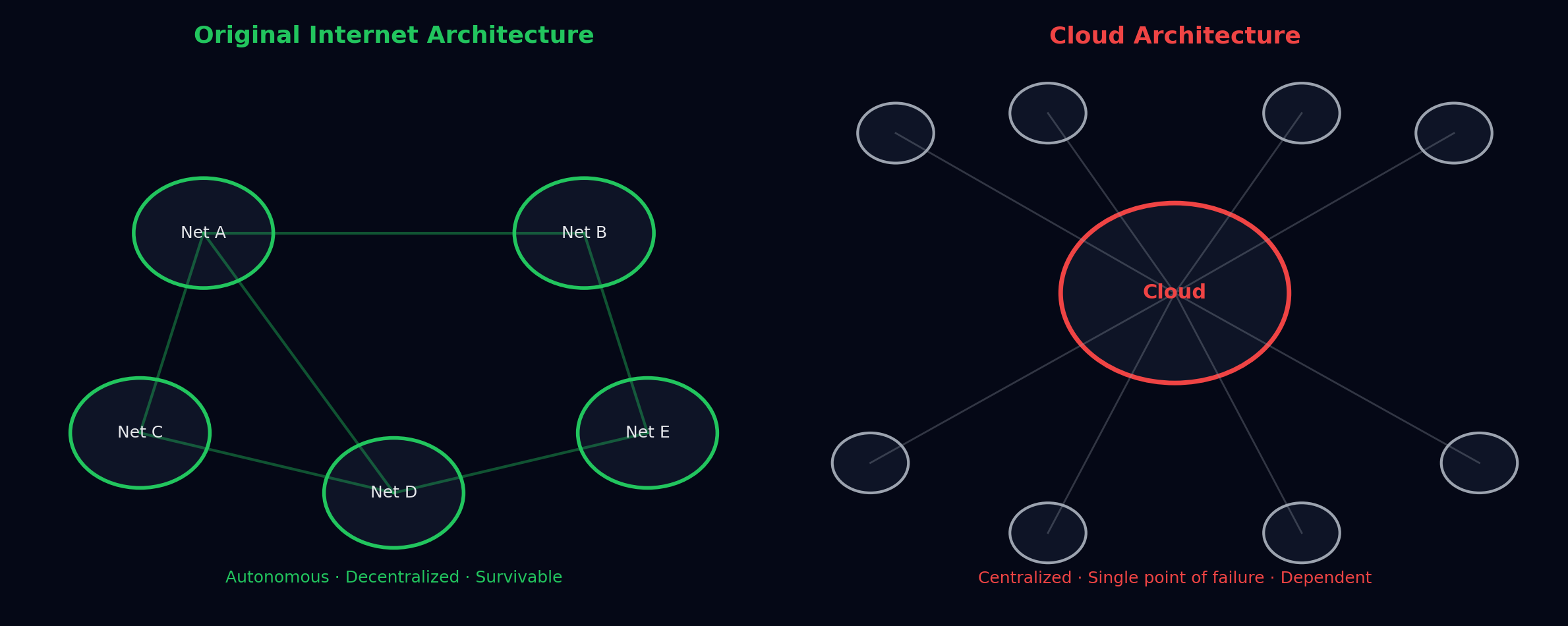
The result is powerful, efficient, and scalable. I'm not going to pretend it isn't.
But it changed the assumptions under which applications operate. And nobody talks about that part.
The Hidden Assumption
Modern cloud-based systems assume three things. The network exists. The network is fast. The network is reliable.
When those assumptions hold, cloud architectures work beautifully.
When they don't, the system collapses. Not degrades. Collapses.
That's fine for office software.
It's not fine for a disaster response team that just lost cellular. It's not fine for a farm in eastern Washington where the nearest reliable connection is a forty-minute drive. It's not fine on a ship, in a mine, at a forward operating base, or in a field hospital where the satellite link costs twelve dollars a megabyte and drops every time it rains.
In those environments, cloud-based systems don't degrade gracefully. They stop. Completely.
What the Internet Was Supposed to Do
The original architecture never required centralized infrastructure. It assumed networks would fail, links would be slow, and connectivity would come and go. Applications were expected to keep working regardless.
We moved away from those assumptions. Cloud computing optimized for reliability through centralization rather than resilience through decentralization.
The Internet didn't stop working. But we stopped using the properties that made it survive.
The Gap
Today we have two kinds of systems. Cloud systems that work beautifully when the Internet is available. And disconnected systems that fall back to simple messaging or bare telemetry when it isn't.
The gap between those two worlds is enormous.
That gap is where I've been working for over a decade.
The question then becomes: what would a network architecture look like if we restored the original Internet principles while acknowledging the realities of modern applications?
FrogNet is a self-forming mesh infrastructure that allows full web applications to operate across any available transport, including environments where the Internet is unavailable.
It doesn't assume connectivity to a central cloud. It restores the idea that networks should operate independently and cooperate when connectivity appears. Every node boots a complete system — web server, database, sensor pipeline, AI — and works by itself from the first second. When nodes find each other, they mesh. When connectivity drops, they split and keep running. When it comes back, they rejoin.
The Internet connected networks.
FrogNet makes those networks capable of running full applications even when the Internet is unavailable.